













Outdoor and Garden Lighting: How to Choose Fixtures That Will Last and Light Properly
The article
In short: an outdoor light fixture is chosen first of all according to where it will be installed: IP44 under a roof, IP65 when exposed to rain, IP67 for in-ground fixtures, and high impact resistance (IK08 to IK10) where people walk over them. Near the sea you need materials and finishes resistant to salt. After that you plan the light: warm (2700K to 3000K), soft (about 5 to 20 lux on paths), aimed down and at the target, and without dazzling those sitting outside or the neighbours.
Outdoor lighting works in far harsher conditions than indoor lighting: direct sun, heat, rain, dust, irrigation, and in coastal areas salt spray too. A fixture chosen only for its looks can look tired after one winter. This guide deals with the technical side of the choice. For garden design ideas, see the articles Tips for choosing and designing outdoor and garden lighting and Ideas for creating original outdoor lighting.
IP rating: by location
The IP rating describes how well sealed the fixture is against dust and water. The first digit refers to dust, the second to water. A full explanation of the scale is in the guide Bathroom lighting and IP zones.
| Position | Accepted rating |
|---|---|
| Covered balcony, under a roof or a closed pergola | IP44 |
| Exterior wall exposed to rain, garden posts | IP54 to IP65 |
| Fixture among the plants, near sprinklers | IP65 |
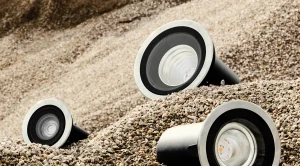
| Fixture recessed into the ground or paving | IP67 |
| In water: pool, fountain | IP68, according to the maker’s depth specification |
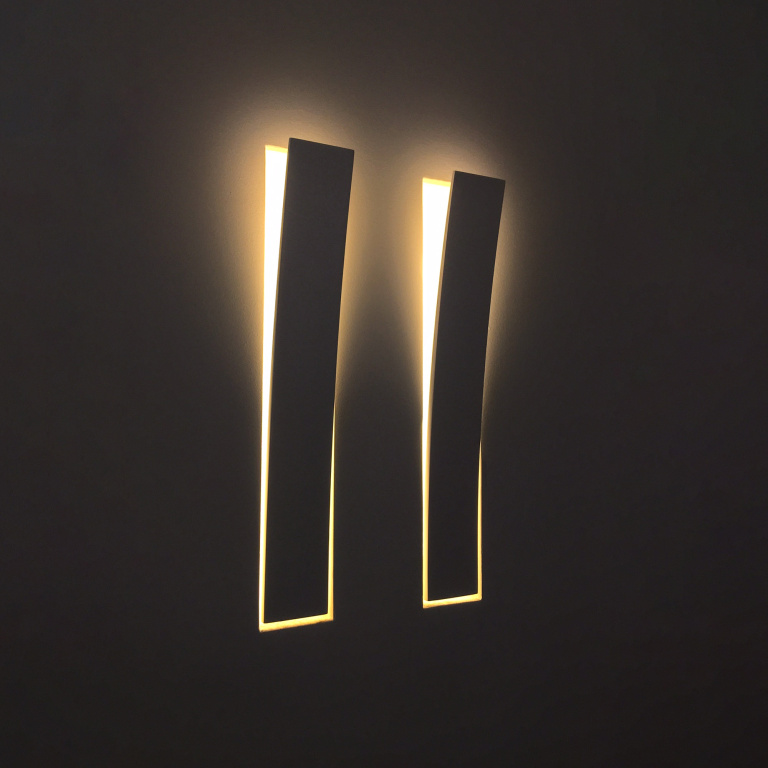
Examples from the catalogue: MAGNET S is an outdoor ceiling light rated IP54; the outdoor wall-recessed light model 11318 is IP67; and Puck by Flexalight is an especially small IP67 recessed fixture. Sealing also depends on the installation: an unsealed cable or an open junction box cancels the fixture’s IP rating.
IK rating: impact resistance
The IK rating, under the IEC 62262 standard, describes how much impact energy the fixture can absorb. IK08 withstands an impact of 5 joules, and IK10 an impact of 20 joules. An in-ground fixture in a spot people walk on, a low fixture on a path used by children and pushchairs, and fixtures in public places need a high rating. For fixtures that vehicles drive over, the permitted load in kilograms, given in the specification, is also checked.
Materials and salt
- Cast aluminium with electrostatic painting is the common material, and it suits most areas when the painting is of good quality.
- 316 stainless steel is more resistant than standard stainless steel (304) in a salty environment, and is therefore recommended near the sea.
- Concrete, stone and brass age beautifully, but change their appearance over time.
- Plastic must be UV-resistant, otherwise it yellows and crumbles.
Good makers state the limitations in the specification. For example, for the outdoor fixture More by Catellani & Smith it is stated explicitly that it is not resistant to salt mist. Near the sea, this is information you must check for every fixture.
Low voltage or 230 volts
A low-voltage system (12 or 24 volts) is fed from a power supply or transformer, and suits small fixtures among the plants, stair lighting and fixtures that may be moved as the plants grow. It is safer to touch and in a wet garden. 230 volts suits powerful fixtures, bollards and fixtures on walls. In both cases: cables suitable for burial, mechanical protection and a residual current device, installed by a qualified electrician. The power supply of a low-voltage system must be sealed enough for its location; for example, in Fil de Fer in the outdoor version by Catellani & Smith the driver is IP67, resin-coated.
How much light is needed outdoors
Outdoors, the eye adapts to the dark, so far less light is needed than indoors. Too much light flattens the garden and causes glare.
| Area | Typical level (lux) |
|---|---|
| Paths | 5 to 10 |
| Stairs | 20 to 50, with light on every step |
| Entrance and door | 50 to 100 |
| Seating area and balcony | 30 to 100, dimmed |
| Outdoor kitchen and barbecue | 200 to 300 on the worktop |
Garden lighting techniques
Paths and steps
Low fixtures that light downwards, or wall-recessed fixtures at ankle height, give safe light without glare. Asymmetric fixtures, such as the Sorel series by Flexalight, throw the light towards the path and not into the eyes. On steps, light from each side or in each tread brings out the edges.
Trees and plants
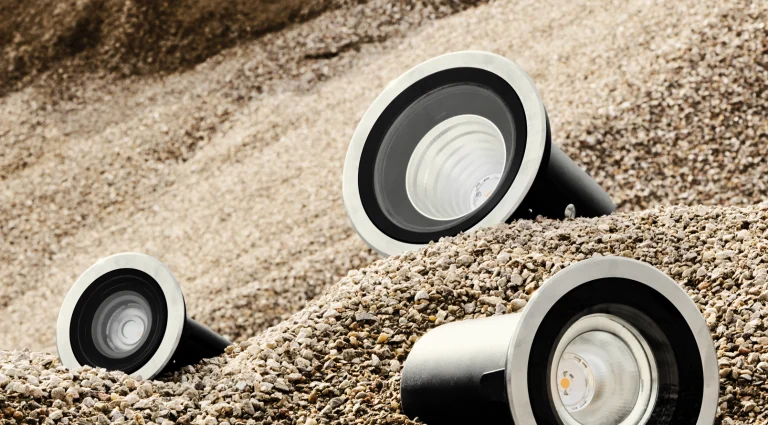
Lighting from below (Uplight) turns a tree into a night-time sculpture. For a narrow, tall tree, a narrow beam; for a tree with a broad crown, a wide beam or two fixtures. An in-ground recessed fixture gives a clean look, but it needs a layer of gravel underneath for drainage, and you need to check that its glass does not get hot where people walk. Light coming from above, from within the tree (Moonlight), creates leaf shadows on the ground.
Walls and façades
A fixture close to the wall that lights along it (Grazing) brings out stone and texture. Wide, even light (Wall Wash) suits a smooth wall. On the wall of the house, a fixture that lights upwards and downwards creates clean lines. For suitable fixtures: surface-mounted outdoor wall lights and outdoor wall-recessed lights.
Balconies and pergolas
Under a pergola you can use surface-mounted and recessed ceiling lights made for outdoor use, as well as decorative fixtures designed for outdoors, such as Fil de Fer outdoor, Sito giro by Occhio, which rotates and adjusts, or BAG Outdoor by Penta. It is worth dimming, and keeping to a warm colour temperature.
Beside a pool and in water
Fixtures inside a pool or fountain are a world of their own: an IP68 rating for the depth the maker specifies, safety extra-low voltage from a power supply installed outside the water zone, and installation and testing by a qualified electrician only. Around the pool, low, indirect light on the paving and the plants is preferable to strong fixtures that reflect in the water and dazzle from the other side.
Colour temperature, glare and the neighbours
- Colour temperature: 2700K to 3000K. Warm light flatters plants, wood and stone.
- Glare: choose fixtures that hide the light source, and position them so that the bright point cannot be seen from the seating areas or from the house.
- Light pollution: aim the light down and at the target, not at the sky or at the neighbours’ windows.
- Control: separate circuits for the entrance, the paths and the garden, and an astronomical timer or a sensor so that the light does not stay on all night.
Example: the garden of a private house
An entrance path of about 15 m, steps to the yard, two large trees, a stone wall and a pergola with a seating area. A possible design:
- Path: low fixtures or recessed wall lights at ankle height, every 2 to 3 metres, with asymmetric light towards the path.
- Stairs: a small recessed wall light beside every step or every second step.
- Trees: two IP67 in-ground fixtures per tree, with a wide beam, on a separate circuit.
- The stone wall: a row of fixtures close to the wall that light along it and bring out the texture.
- Pergola: a decorative outdoor fixture above the table, dimmed, and two ceiling lights for general light.
- Control: entrance and path on an astronomical timer; trees and wall until midnight; pergola on a switch with dimming.
- Colour temperature: 2700K or 3000K in all fixtures.
The result: a garden that looks deep and interesting from the house, with safe paths, without one strong floodlight that flattens everything.
Maintenance
Outdoor fixtures need their glass cleaned of dust and of limescale from the sprinklers, their seals checked, and any plants that hide them pruned. In-ground fixtures need proper drainage. It is worth keeping the specification sheet of each fixture, with its IP and IK ratings, for future replacement. And once a year, before winter, it is worth going round all the fixtures in the evening: checking that they all light up, that the aiming has not shifted, and that plants that have grown are not blocking the light or heating up next to a fixture.
For all models: Outdoor lighting, and in detail: In-ground fixtures, Outdoor lighting columns, Outdoor ceiling lights and Outdoor recessed ceiling lights. A private house project with outdoor lighting can be seen on the page Beit Zayit.
Questions and answers
What IP rating does outdoor lighting need?
Under a roof or a closed pergola, IP44 is usually enough. A fixture exposed to rain needs IP65. A fixture recessed into the ground, where water may collect around it, needs IP67, and inside water only IP68, as defined by the manufacturer.
What is IK?
Impact resistance rating, under the IEC 62262 standard. IK08 withstands an impact of 5 joules and IK10 an impact of 20 joules. In-ground fixtures, low fixtures beside paths and fixtures in public places need a high rating.
Low voltage or 230 volts in the garden?
A low-voltage system, 12 or 24 volts, is safer and makes it easy to move fixtures, and it suits small fixtures among the plants. 230 volts suits more powerful fixtures and posts. In both cases, the wiring and protection are in the hands of a licensed electrician.
Which colour temperature suits a garden?
2700K to 3000K. Warm light flatters plants, stone and wood, and looks natural at night. Cool light makes a garden look like a car park.
How to prevent glare and light pollution?
Aim the light downwards and at the target, choose fixtures that hide the light source, do not light towards neighbours’ windows or the sky, and use a timer, a sensor or an astronomical timer so that the light does not stay on all night.