













Bathroom Lighting: Safety Zones, IP Ratings and Mirror Lighting
The article
In short: in bathroom lighting, or lighting for a shower room, each light fixture is chosen according to its distance from the water. Inside the bath or the shower tray, only fixtures at extra-low voltage and sealed to IPX7 are allowed; above them and up to a height of 2.25 metres you need at least IPX4; and in the rest of the room IP44 is a sensible choice because of the humidity. All circuits are protected by a residual current device, and the installation is done by a qualified electrician. For comfort: light from the sides of the mirror at face height, 3000K to 3500K and a CRI of 90 and above.
Bathroom lighting is the only case in the home where choosing a light fixture is first of all a question of safety, and only then of design. The guide explains both layers: what the rules are, and how to light the room so that it is pleasant to use.
What is an IP rating
The IP (Ingress Protection) rating, under the IEC 60529 standard, describes how well sealed the light fixture is. It is made up of two digits:
- The first digit (0 to 6): protection against the entry of solid objects and dust. 4 means protection against objects over one millimetre; 5 dust-protected; 6 dust-tight.
- The second digit (0 to 8): protection against water.
| Second digit | Protection against | Example in a bathroom |
|---|---|---|
| 0 | No protection | Only far from water, in a dry room |
| 4 | Water splashing from any direction | Above a bath, near the basin |
| 5 | Water jet | Shower cleaned with a hose or a water jet |
| 7 | Temporary immersion (up to one metre) | Inside a bath or in the base of a shower |
| 8 | Prolonged immersion | Pools and jacuzzis, as defined by the maker |
When an X appears in place of a digit, for example IPX4, it means the fixture was not tested for that aspect. IP44 and IP65 are the most common ratings in fixtures for bathrooms.
The safety zones around water
The international standard for electrical installations in bathrooms, IEC 60364-7-701, divides the room into zones according to the distance from the water. In Israel, installation is subject to the Electricity Law and its regulations, which may differ in the details; so this is a model for understanding and planning, and the final decision is the licensed electrician’s.
| Area | Where | What the international model allows |
|---|---|---|
| Zone 0 | Inside the bath or in the base of the shower | Only fixtures at safe extra-low voltage (SELV, up to 12V AC or 30V DC), rated IPX7, with their power supply outside the zones |
| Zone 1 | Above zone 0, up to a height of 2.25 m from the floor | At least IPX4; IPX5 if cleaned with a water jet |
| Zone 2 | 60 centimetres beyond zone 1, horizontally and up to the same height | At least IPX4 |
| Outside the zones | The rest of the room | No special requirement, but the humidity justifies IP44 |
In addition, according to the same model, all the circuits in the bathroom are protected by a 30-milliamp residual current device. In a shower without a tray, the zone is measured from the point where the water comes out. In small rooms almost the whole ceiling falls within one of the zones, so it is simpler to choose IP44 or higher for all the fixtures.
How to light a bathroom properly
General light
150 to 300 lux is enough for general light. In a small room, two to four recessed spotlights with a suitable sealing rating, or a single diffusing ceiling light, give even light. For example, recessed fixture IP44 model 11246 and recessed ceiling light IP44 model 11284 are rated for wet spaces.
Mirror lighting: at the sides and above the mirror
This is the most important light in the room: this is where you shave, put on make-up and check your skin. It needs to give 300 to 500 lux on the face, and to come from the front and the sides.
- Wall lights on both sides of the mirror, at face height, about 150 to 170 centimetres from the floor. This is the solution that gives the fewest shadows.
- A linear fixture above the mirror that spreads light forwards and down. Good when there is no room at the sides.
- A mirror with integrated lighting, provided it lights the face and not just the wall.
A single spotlight directly above the basin, with no other light, creates shadows under the eyes, the nose and the chin. If there is only the ceiling, two spotlights in front of the mirror, close to the wall, are better than one overhead.
Shower and bath lighting
A recessed spotlight in the shower ceiling must be sealed, usually IP65, and have recessed optics that do not dazzle when you look up under the stream of water. In the Kol and Joel 6 series by Flexalight, for example, the fixtures are rated IP65 and are also designed for humid environments, and in the Bouly recessed ceiling light, protection against water is part of the model’s specification. A niche in the shower wall can be lit with a low-voltage LED strip, in a sealed profile and with an IP rating suited to the zone. On choosing LED strips, see LED strip lighting: everything you wanted to know.
Night light
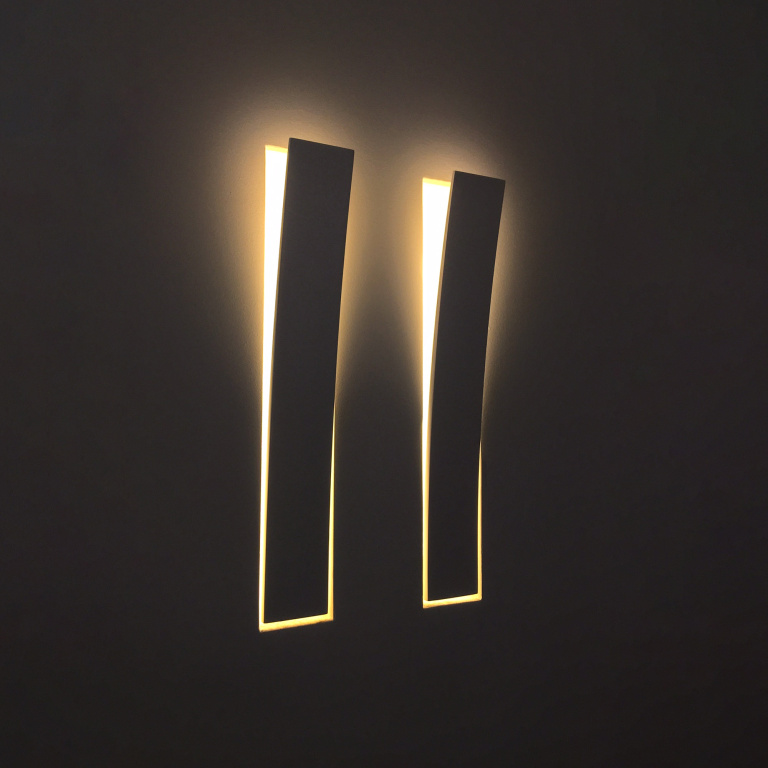
A dimmed LED strip under the wall-hung cabinet or a small wall-recessed fixture near the floor lets you walk in at night without switching on all the light. Warm colour temperature and very low output. You can choose from wall-recessed light fixtures or plaster wall-recessed fixtures, with an IP rating suited to the location.
Colour temperature and colour rendering
In the bathroom you see your face and skin, so colour rendering is especially important: a CRI of at least 90, and preferably a good R9 value. A colour temperature of 3000K to 3500K gives clean light that is still pleasant; 2700K suits an en-suite bathroom, which is used mainly in the evening. A full explanation in the guide to colour temperature and colour rendering.
Technical points worth checking
- Position of the drivers and transformers: outside the wet zones, in a ventilated, accessible place, for example in the plasterboard ceiling above the corridor or behind a service hatch.
- Humidity and condensation: even a fixture that is not above the water is exposed to steam. Good ventilation extends the life of the fixtures.
- Materials and finishes: painted aluminium, stainless steel and glass last; unprotected metal parts may rust.
- Sealing over time: sealing also depends on correct installation, gaskets and cables. An IP65 fixture installed with an unsealed opening is no longer IP65.
- Dimming: especially useful in the bathroom in the evening. Make sure the fixtures and drivers support the dimming method. See LED dimming and drivers.
Two examples
A small bathroom, about 4 m², with a shower cubicle
Two IP65 recessed spotlights with recessed optics: one above the shower and one close to the door, for general light. Above the basin, a linear fixture above the mirror or a mirror with lighting that shines forwards, because in a narrow room there is no space for lamps at the sides. A dimmed LED strip under the vanity unit for night lighting. All the fixtures at 3000K, and two circuits: general light and mirror, and night lighting.
An en-suite bathroom, about 8 m², with a bath and a shower
Four recessed spotlights for general light, each with a rating suited to its zone. Two wall lights on either side of the mirror, at face height. A sealed, narrow-angle spotlight above the bath, dimmed, for atmosphere. A niche in the shower with a sealed low-voltage LED strip. A colour temperature of 2700K to 3000K, and dimming for the general light and the bath. The drivers sit in the plasterboard ceiling of the corridor, behind a service hatch.
What not to do
- Installing an ordinary indoor fixture (IP20) above the shower “because it is far enough away”. Steam and water reach further than you think.
- Placing a transformer or driver inside the shower ceiling, directly above the water.
- Choosing a spotlight with protruding glass and a shiny reflector above the bath, which dazzles anyone lying in it.
- Using an ordinary, non-sealed LED strip in the shower niche.
- Lighting the mirror only from above, with a narrow spotlight.
Checklist before buying
- For each fixture: which zone it will be installed in, and what its IP rating is.
- Light for the mirror from the sides or the front, not only from above.
- A uniform colour temperature and a CRI of at least 90.
- Recessed optics above the shower and the bath.
- Low night lighting.
- A plan approved by a licensed electrician.
For planning the whole home, see How to plan lighting for a whole apartment. For choosing spotlights by beam angle and glare: the guide to recessed spotlights.
Bathroom light fixtures from the catalogue, by protection rating
These are models whose protection rating appears in the product data. The protection rating is the first condition, not the only one: the electrician determines in which zone each fixture may be installed.
- SPOT SURFACE ROUND by Tom Dixon: a wall light in a copper finish, with an IP44 rating.
- SPOT SURFACE OBROUND by Tom Dixon: an elongated wall light in a copper finish, with an IP44 rating.
- POSE R22: a ceiling light for indoor lighting, with an IP44 rating, with a 15W LED in 3000K.
- Round recessed fixture model 11245: a recessed ceiling light with an IP44 sealing rating, also rated for wet spaces.
- Recessed ceiling light model 11284: a recessed ceiling light with an IP44 rating, in 3000K, 4000K or 6000K.
- Akita 1: a small recessed wall light with an IP65 rating, with a 3W, 50 lm LED; an option for low night light.
For all models: Recessed ceiling light fixtures, Recessed wall light fixtures and Wall-mounted light fixtures. On every model page it is worth checking the IP rating before choosing.
Questions and answers
What IP rating does a bathroom need?
Above the bath and inside the shower enclosure up to a height of 2.25 m: at least IPX4, and IPX5 if cleaned with a water jet. Inside the bath or the shower base: IPX7 and extra-low voltage only. In the rest of the room there is no special requirement under the international model, but IP44 is a reasonable choice because of the humidity.
What do the two digits in IP mean?
The first digit describes protection against the ingress of solid objects and dust, from 0 to 6. The second digit describes protection against water, from 0 to 8: 4 is protection against splashing from any direction, 5 against water jets, 7 against temporary immersion and 8 against prolonged immersion. An X in place of a digit means that aspect was not tested.
How to light a bathroom mirror?
Best from the sides, at face height, about 150 to 170 centimetres from the floor, or from a fixture above the mirror that spreads light forwards. A single spotlight straight above the basin creates shadows under the eyes and the chin.
Can an ordinary spotlight be installed in the shower ceiling?
No. Above the shower you need a fixture with a sealing rating suited to the zone, at least IPX4 and usually IP65, preferably with recessed optics that do not dazzle when you look up. Installation is carried out by a licensed electrician.
Which colour temperature suits a bathroom?
3000K to 3500K with a CRI of at least 90, so that skin tones and make-up look right. For night lighting, very warm, very dim light is better, low down near the floor.