













Recessed Spotlights: How to Choose Diameter, Beam Angle, Glare (UGR) and Frameless Installation
The article
In short: a good recessed spotlight is chosen by five figures: the amount of light in lumens, the beam angle, the glare level (UGR), colour rendering (CRI) and the type of installation, with or without a frame (Trimless). Watts only indicate power consumption. For general light in a ceiling of about 2.60 metres, a beam of 36 to 60 degrees and a spacing of 1.2 to 1.8 metres between spotlights are suitable; for accent light, a beam of 15 to 25 degrees.
Recessed spotlights are probably the most common light fixture in new homes and renovations, and precisely because of that it is easy to choose them badly: by price, by wattage, or by what was in the neighbours’ apartment. This guide deals with the technical side of the choice. For design ideas by room there is the guide to choosing recessed lighting for the home.
Why wattage does not tell you how much light there is
With the incandescent bulbs of the past, higher power meant more light. With LED this is no longer true. The amount of light a fixture emits is measured in lumens (lm), and its efficiency in lumens per watt. Two 10-watt spotlights can give amounts of light that differ by tens of percent, depending on the quality of the LED chip, the driver and the optics. When comparing, compare lumens with lumens, and preferably the lumens coming out of the fixture itself rather than those of the chip alone.
Diameter and cut-out
The diameter is first of all an aesthetic decision: a small spotlight disappears into the ceiling, a large spotlight is noticeable in it. But it also has consequences. A larger fixture usually allows more light and better heat dissipation. A very small fixture suits accent lighting, niches and ceilings you want to look clean.
| Size | Typical cut-out diameter | Typical use |
|---|---|---|
| Mini | About 30 to 50 mm | Accent lighting, niches, cabinets, minimalist ceilings |
| Standard | About 60 to 80 mm | General light and task light at home |
| Large | About 85 mm and above | High ceilings, public spaces and shops |
The exact diameter varies from maker to maker and is given on the specification sheet. Before buying, check the required cut-out and installation depth, and make sure that the plaster drop ceiling has enough room for the fixture, the cooling fins and the driver.
Beam angle: how wide the light is
The beam angle determines the width of the circle of light. The diameter of the circle can be estimated like this: twice the distance from the fixture, times the tangent of half the angle. A 36-degree spotlight at a height of 2.60 metres gives a circle of about 1.7 metres on the floor; a 24-degree spotlight at the same height gives a circle of about 1.1 metres.
| Angle | Common name | Suitable for |
|---|---|---|
| Up to 15 degrees | Very narrow | A single item, a very high ceiling, a dramatic effect |
| 15 to 25 degrees | Narrow | Picture, kitchen island, table, display shelf |
| 25 to 40 degrees | Medium | General light in a low ceiling, broad accent lighting |
| 40 to 60 degrees | Wide | General light, wall lighting |
| Over 60 degrees | Very wide | Soft, even light, low ceilings |
The simple rule: the higher the ceiling, the narrower the beam needs to be for the light to reach down. And in living spaces, several spotlights at different angles give a more interesting result than a uniform grid of identical spotlights.
Spacing and distance from the wall
- Spacing between spotlights for general light: roughly the ceiling height, when the beam is wide. In a 2.60-metre ceiling, about 1.2 to 1.8 metres from one spotlight to the next.
- Distance from the wall for general light: roughly half the spacing, about 50 to 90 centimetres.
- Lighting a whole wall (Wall Wash): about a third of the ceiling height away from the wall, with a wide beam or dedicated wall-lighting optics.
- Texture emphasis (Grazing): 15 to 30 centimetres from the wall, so that the light skims across the surface of the stone or brick and brings it out.
- A picture on the wall: aim at an angle of about 30 degrees from the vertical. With a 2.70-metre ceiling and a picture centred at a height of 1.60 metres, the spotlight will be about 60 to 65 centimetres from the wall. This needs an adjustable spotlight.
Glare and UGR
Glare is the discomfort you feel when you look at a bright light source against a darker background. At home this happens when you sit on a sofa or lie in bed under a spotlight, or when you see the bare LED point from an oblique angle.
The accepted measure is UGR (Unified Glare Rating). The lower the number, the less the glare. The European standard for the lighting of workplaces, EN 12464-1, requires a UGR of 19 or less in offices, and this is a good target for the home too, in areas where people sit for a long time. Values around 22 to 25 are acceptable in corridors and in spaces people pass through.
What actually reduces glare:
- A light source set deep inside the fixture, so that it cannot be seen unless you look from almost directly below.
- A dark reflector or dedicated optics instead of a shiny reflector.
- A honeycomb louvre or anti-glare filter at the opening of the fixture.
- Correct position: not directly above the sofa, the bed or the chair at the head of the table.
Examples from the catalogue: the Leaf 6 UGR series by Flexalight is built in a dedicated low-glare version, and in the Joel 6 series an anti-glare filter can be added to the adjustable fixture.
With or without a frame: the Trimless spotlight
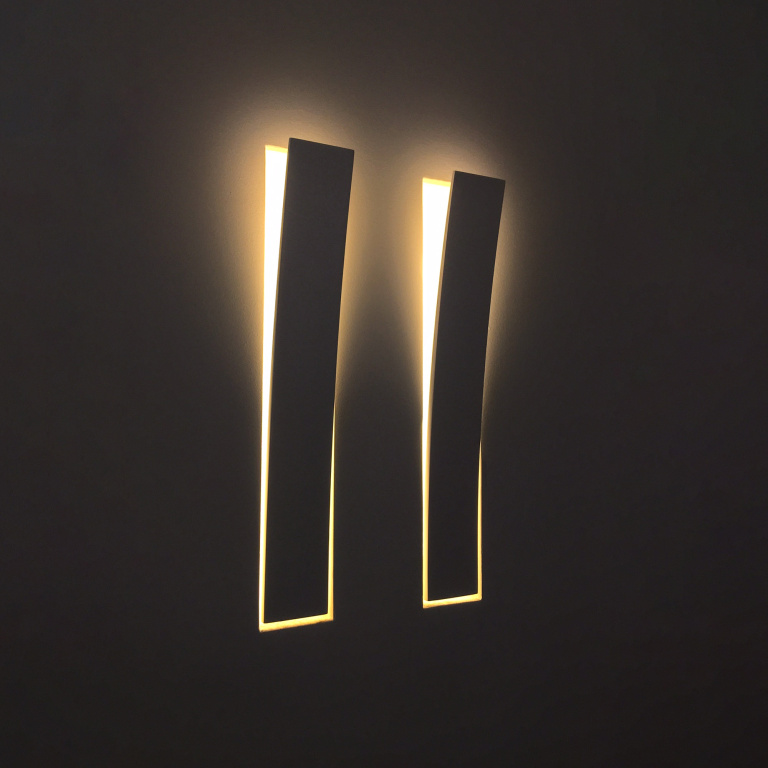
A standard spotlight is installed under a finished ceiling: you cut a hole, insert the fixture, and the rim (the frame) covers the edges of the cut. A frameless (Trimless) spotlight is installed in a special frame that goes into the plasterboard during construction, and filler and paint are then smoothed over it. The result is a light opening that looks as if it was cut into the ceiling itself.
| With a frame | Trimless | |
|---|---|---|
| Mirror | The language is visible | Only the light opening is visible |
| When to decide | Possible after painting, too | Must be done at the plasterboard construction stage |
| Moving or replacing | Relatively simple | Requires plaster work and painting |
| Installation | Electrician | Electrician and plasterer, in coordination |
If you choose Trimless, the exact model has to be chosen before the plasterer starts, because each series has its own frame.
Fixed, adjustable or extended
A fixed spotlight shines straight down and suits general light. An adjustable spotlight rotates and tilts, usually up to 30 degrees or more, and suits accenting pictures and walls and correcting the position when the point is not exactly above the target. A deep-recessed spotlight hides the light source and is especially suitable when reducing glare matters.
The data you must check in the specification
- Lumens of the fixture, not just of the chip.
- Colour temperature in kelvin, the same for all fixtures in the space. See the guide to colour temperature and colour rendering.
- Colour rendering: a CRI of at least 90 for the home. A high R9 value matters for the kitchen and for skin tones.
- Colour consistency between fixtures: an SDCM (MacAdam steps) of 3 or less.
- Beam angle and the option to change the optics.
- UGR, when the maker publishes it.
- Sealing rating: at least IP44 in a bathroom, and in the shower according to the zone. See bathroom lighting and IP zones. For example, Kol by Flexalight and the Bouly recessed ceiling light are rated for damp environments.
- Driver type and dimming: constant current (for example 350 or 500 milliamps) or constant voltage, and which dimming method is supported. See LED dimming and drivers.
Example: a living room of 5 by 4 metres
In a plasterboard ceiling 2.60 m high, a reasonable design would include two rows of three spotlights with a beam of 36 to 40 degrees, about 70 cm from the long walls, for the general light; two or three adjustable narrow-angle spotlights facing the picture wall or the bookcase; and a separate circuit for each group. Reading light by the sofa will come from a floor lamp, not from a spotlight above your head. All the spotlights are chosen from the same series and in the same colour temperature.
For all models: Recessed ceiling light fixtures, Recessed plaster ceiling fixtures and Recessed wall light fixtures. For planning the whole home, see How to plan lighting for a whole flat.
Questions and answers
How far from the wall is a recessed spotlight installed?
For general light, about 50 to 90 centimetres from the wall, roughly half the spacing between the spotlights. To light a whole wall (Wall Wash), a distance of about a third of the ceiling height is usual, and to bring out the texture of a stone or brick wall the fixtures are installed very close, about 15 to 30 centimetres.
Which beam angle suits a home?
For general light in a standard ceiling, a beam of 36 to 60 degrees is suitable. To highlight a picture, a kitchen island or a particular item, a narrow beam of 15 to 25 degrees is suitable. In a high ceiling a narrower beam is needed for the light to reach down.
What is UGR, and what is a good value?
UGR is a measure of the glare a light fixture causes to whoever looks towards it. The lower the number, the less the glare. In offices the European standard requires 19 or less, and this is also a good target at home in places where people sit for long periods.
What is a Trimless spotlight?
A spotlight without a frame, whose rim merges into the ceiling so that only the light opening is visible. It is installed with a special frame at the plasterboard stage, before filling and painting, so it has to be decided on early.
Does a spotlight with more watts give more light?
Not necessarily. With LED, the wattage indicates electricity consumption. The amount of light is measured in lumens, and two spotlights of the same power can give very different amounts of light, depending on the quality of the LED and the optics.