













Concealed Lighting in Plasterboard and LED Profiles: Cornice, Floating Ceiling and Light Line, and How to Plan
The article
In short: concealed lighting is light whose source cannot be seen: an LED strip hidden inside a plaster profile or an aluminium profile, in a cornice, at the edges of a floating ceiling, in a niche or on a shelf, so that what you see in the room is the light reflected from the ceiling or the wall. It gives soft, even light and atmosphere, and emphasises the lines of the architecture, but in most cases it does not replace the general lighting. All its decisions are made before the plasterer starts: the type of profile, the direction of the light, the LED strip, the position of the driver and access to it.
What makes concealed lighting good or mediocre is not the LED itself but the detail: exactly where it sits, how far it is from the surface it lights, and from what angle it is seen. That is why the guide is organised by type of detail, with the profiles in the catalogue, followed by what needs to be planned and which mistakes are worth knowing about.
How concealed lighting works
The LED strip is hidden behind a lip, inside a channel or above a shelf, and lights a surface: a ceiling, a wall, a floor or a curtain. That surface becomes the light source. A light, matt surface reflects soft, even light; a glossy surface reflects the LED dots. And the closer the strip is to the surface, the stronger the light near the strip and the faster it fades. That is why the profile, and not only the type of LED, determines the result.
Types of concealed lighting in plasterboard, with profiles from the catalogue
A cornice between the wall and the ceiling
The classic detail: a cornice along the wall, with an LED strip inside that shines upwards and washes the ceiling. The sloped cornice for concealed lighting (model 11358) is installed between the wall and the ceiling with a subtle reveal from the wall; the LED sits in its inner part and shines upwards, and spotlights can be integrated in its lower part. The stepped cornice (model 11355) is also installed between wall and ceiling, and spotlights can be integrated in it too.
Floating ceiling
A floating ceiling is a lowered ceiling that looks as if it is hovering, thanks to a strip of light along its edges. The plaster edge profile for a floating ceiling (model 11356) is used to separate the ceiling from the wall with concealed lighting, and the edge profile for a floating ceiling (model 11350) combines an aluminium profile with Perspex, giving direct light along the edges instead of indirect light. When the ceiling is built on several levels, the convex lighting profile (model 11361) also serves as the transition between the levels, with a shadow gap and concealed lighting on one side.
A light line inside the wall or ceiling
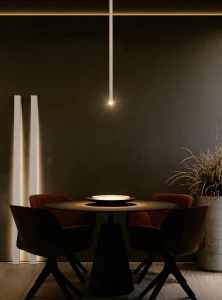
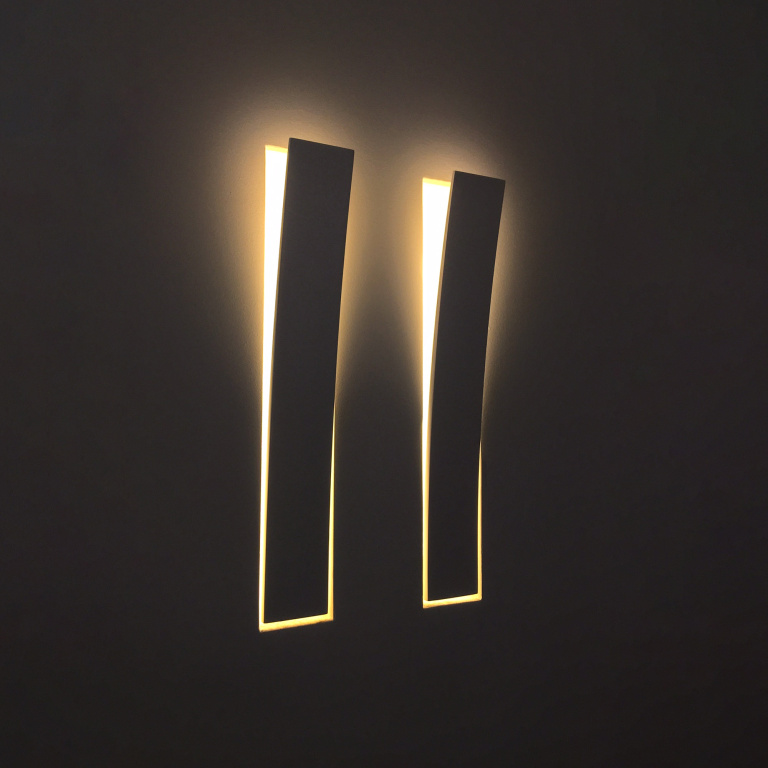
Here the light is not reflected off a surface but comes out of a thin slot in the plaster. The plaster profile for concealed lighting in the wall or ceiling (model 11341) creates a subtle line of light within the wall or ceiling; the line can be directed in different directions, and it can be run from the wall to the ceiling and back, as a single line passing between the planes. Model 11348 is built for two LED strips, for stronger light, and also makes it possible to cross lines of light. And the profile with a Perspex cover (model 11349) is a trimless aluminium channel that is absorbed into the plaster, with a Perspex cover, in a range of sizes; according to the product page, it is designed for easy installation without cracks.
Angled light: on the floor, on the ceiling or on the pictures
The angled concealed lighting profile (model 11340) projects a straight beam at an angle, and model 11347 a beam that widens. The same profile does three different things depending on where it is installed: at the bottom of the wall it lights the floor, a common solution in corridors and for night light; at the top of the wall it lights the ceiling; and in the ceiling it lights the wall or pictures hanging on it. When you want to light a whole wall evenly, and not just a strip along it, wall washer fixtures are more suitable: wall washing and floodlighting.
Curtain pelmet, shelf and frame
Concealed lighting doesn’t have to be in the ceiling. The curtain pelmet with a flat finish (model 11359) and the one with a rounded finish (model 11360) hide the curtain’s hooks, rods or motor and incorporate concealed lighting at different angles, so that the curtain itself is lit in the evening. The shelf or partition with a wing for concealed lighting (model 11362) is installed on a single track, and can be ordered in special sizes for a sideboard, a shelving unit or a piece of furniture. And the frame profile with two-sided lighting (model 11353) creates a frame lit on both sides.
Plaster profile or aluminium profile
A plaster profile is built as part of the wall or ceiling and is filled and painted together with them, so it disappears into the construction. An aluminium profile, or LED profile, is a ready-made channel that the LED strip goes into, usually with a diffuser cover. It helps dissipate the LED’s heat, hides the dots, and also suits places where there is no plasterboard.
The catalogue includes an aluminium profile for wall-to-wall or wall-recessed installation (model 11319), whose page details three LED strip outputs: low (8.64 watts and 950 lm per metre, with a cutting point every 16.7 cm), medium (14.4 watts and 1,560 lm per metre, cut every 10 cm) and high (24 watts and 2,640 lm per metre, cut every 5 cm), in 3000K and in other colour temperatures to order. These two figures matter for every LED strip: the lumens per metre determine how much light the line gives, and the cutting interval determines how closely the length can be matched to the niche without leaving a dark end.
What to decide before the drywall installer starts
- Where the light goes: to the ceiling, to the wall, to the floor or straight into the room. This determines the type of profile.
- Where it is seen from: it is worth checking the line of sight from the sofa, the bed and the entrance, so that the strip itself is not visible below the lip.
- How much light: concealed lighting with a weak strip mainly gives atmosphere; when it is also meant to serve as general light, you need a stronger strip, and usually spotlights as well. On planning the spotlights: recessed spotlights: how to choose.
- Colour temperature: the same as the rest of the lighting in the room, usually 2700K to 3000K at home. The explanation: colour temperature and colour rendering.
- Driver and dimming: LED strips usually work at low voltage with a power supply, which needs a ventilated, accessible place not too far from the strip. Choose the dimming method in advance: LED driver and dimming.
- Corners and joins: where the strip starts and ends, and how it turns a corner, without a dark section or a bright spot.
Common mistakes
Dots on the wall: an LED strip too close to the surface, or a strip with sparse LEDs, leaves a row of dots instead of a continuous line. A strip visible from below: a lip that is too low exposes the LEDs to whoever is sitting in the room. No access to the driver: a power supply sealed inside the plasterboard without a service hatch turns a small fault into breaking open the ceiling. Dust: a cornice open at the top collects dust, so plan it so that it can be reached for cleaning. Different colour temperatures: a 4000K strip next to 3000K spotlights looks like a mistake, even when each is good on its own.
For all the lighting profiles on the site: Plaster profiles for LED lighting and Aluminium profiles for LED lighting. More on LED strips themselves: LED light strips: everything you wanted to know, and on recessed lighting in the home: The guide to choosing recessed lighting for the home.
Questions and answers
What is concealed lighting?
Lighting whose light source, usually an LED strip, is hidden inside a profile, a cornice, a lowered ceiling or a shelf. You see the light reflected from the ceiling or the wall, and not the LED itself.
What is the difference between a plaster profile and an aluminium profile?
A plaster profile is built as part of the wall or ceiling and is filled and painted together with them. An aluminium profile is a ready-made channel for an LED strip, usually with a diffuser cover, which helps dissipate the heat and hide the LED dots.
Is concealed lighting enough as the only light in a room?
Usually not. Concealed lighting gives soft light and atmosphere. When it is also meant to serve as general light, a stronger LED strip is needed, and most rooms also need spotlights or other fixtures for work and reading.
Why do you see spots on the wall with concealed lighting?
Usually because the LED strip is too close to the surface it lights, or its LEDs are spaced too far apart. A greater distance from the surface, a denser strip or a profile with a diffusing cover gives a continuous line.
When should concealed lighting be planned?
Before the plasterboard work. The type of profile, the direction of the light, the location of the driver and access to it are decided during construction, and they are very hard to change once the ceiling is closed and painted.