













Lighting for Shops and Showrooms: How Much Light, What Colour Temperature and How to Highlight the Merchandise
The article
In short: in a shop, the lighting should lead the eye to the merchandise. Start with general light of about 300 to 500 lux, add accent light three to ten times stronger on the key products, choose the colour temperature according to the type of merchandise (usually 3000K to 3500K in fashion, 3000K or 4000K in jewellery, 3500K to 4000K in sport and electronics) and insist on colour rendering of 90 and above. A three-phase track lets you move and change all this when the display changes.
At home, lighting has to be comfortable. In a shop it is part of the sale: it determines where the customer looks, how long they stay and how the merchandise looks to them. This guide summarises the accepted principles of commercial lighting design, with the numbers, and points to shop projects shown on the Barami Lighting site.
Three layers of light in a shop
General light
The light that lets people find their way and move around. The European standard for the lighting of workplaces, EN 12464-1, specifies about 300 lux for a normal sales area and 500 lux in large stores and at the checkout, with colour rendering of at least 80 and limited glare. In luxury stores the general light is deliberately lower, so that the accent lighting stands out.
Accent light
This is the light that sells. Directional spotlights light mannequins, shelves, display tables and brand walls. Accent lighting is measured relative to the general light:
| Accent ratio | The impression | Suitable for |
|---|---|---|
| 2 to 1 | Barely noticeable | Supermarket, shop with a uniform display |
| 3 to 1 | Noticeable | Most shops |
| 5 to 1 | Surface-mounted | Fashion, design, selected products |
| 10 to 1 | Dramatic | Jewellery, boutiques, shop windows |
| 15 to 1 and above | Very dramatic | A single item, a gallery |
Light on the walls
A customer who walks into a shop judges it first and foremost by its walls. A lit back wall draws people in, and well-lit wall shelves make the shop look bigger to the customer. This is usually done with Wall Wash fixtures or with a row of spotlights at a fixed distance from the wall.
Colour temperature and colour rendering by type of shop
| Type of shop | Usual colour temperature | Colour rendering |
|---|---|---|
| Fashion and boutiques | 3000K to 3500K | 90 and above, good R9 |
| Sport and young fashion | 3500K to 4000K | 90 |
| Jewellery | 3000K for gold, 4000K for silver and diamonds | 90 to 95 and above |
| Electronics | 4000K | 80 to 90 |
| Wine, delicatessen and bakery | 2700K to 3000K | 90, good R9 |
| Furniture, design and lighting | 2700K to 3000K, as at home | 90 and above |
Poor colour rendering makes the customer see one colour in the shop and another at home, and that is a well-known reason for returns. A full explanation is in the guide Colour temperature and colour rendering.
Track: the main tool in a shop
The display in a store changes every season, so the lighting needs to move with it. That is why most stores work with tracks. A three-phase track makes it possible to divide the spotlights on the same track into three groups that switch on separately, for example sales lighting, cleaning lighting and night lighting for the shop window. The differences between a track and a magnetic track are explained in the track guide, and the spotlights themselves can be seen in the category Track spotlights.
Beam angles
- 10 to 15 degrees: a piece of jewellery, a single item, a display case.
- 20 to 30 degrees: a mannequin, a display table, a group of products.
- 40 degrees and above, or Wall Wash: wall shelving and brand walls.
Distance from the wall
To light a wall shelf without dazzling the customer, and without the upper shelf casting a shadow on the lower one, aim at an angle of about 30 degrees from the vertical. With a ceiling 3.5 metres high and the centre of the display at 1.5 metres, the track will be roughly 1.1 to 1.2 metres from the wall.
The shop window
By day, the shop window competes with sunlight and the reflections of the street, so it needs much more light than the shop itself, usually at a higher accent ratio than in the table above. At night the output can be lowered. An astronomical timer or a control system that adapts the light to the time of day saves electricity and keeps the window prominent. Powerful spotlights aimed from above and from the sides, and sometimes from below as well, give mannequins and products volume.
Fitting rooms
The fitting room is where the decision is made. A single spotlight overhead creates shadows on the face and the body and flatters no one. Light from the front and the sides, at face height, is better, for example vertical fixtures on both sides of the mirror, at 3000K to 3500K and with colour rendering of 90 and above.
Checkout, storeroom and aisles
At the checkout, work light of about 500 lux is needed, without glare for the salesperson or the customer. In the storeroom and staff rooms functional light is enough, and there presence sensors save electricity. In the aisles, recessed spotlights or linear fixtures give even general light. For choosing recessed spotlights by angle and glare: the guide to recessed spotlights.
Furniture, kitchen and lighting showrooms
In a showroom the customer tries to imagine the product in their own home, so the lighting should be close to home lighting: a warm colour temperature, layers of light, decorative fixtures and dimming, not uniform office light. “Corners” are built, each lit like a room. The accent lighting is subtler than in a fashion shop, because the customer also needs to see the space as a whole.
Electricity, maintenance and savings
- Division into circuits: shop floor, shop window, signage, storeroom and night lighting, each one separate.
- Consistency: spotlights from the same series, in the same colour temperature and with the same colour rendering. In retail, a difference in colour temperature between two spotlights stands out immediately on a white wall.
- Heat: LED produces much less heat than the spotlights of the past, but it too needs good ventilation in the ceiling to last.
- Maintenance: choose a system for which spare parts and additions can be obtained for years to come.
- Control by time of day: in a shop with a large window onto the street or the shopping centre, automatically lowering the general light during quiet hours and the shop window after closing saves electricity without spoiling the look. A DALI system or a simple controller does this without staff having to remember.
Signage, brand wall and measurement after installation
The brand wall, the logo behind the till or behind the counter, is the shop’s reference point, and it is worth giving it its own light: a concealed light line, Wall Wash or aimed spotlights, on a separate circuit. After installation it is worth measuring: a simple lux meter shows whether the general light and the light on the products are close to what was planned, and whether the accent ratios have been kept. This is also the time to aim each spotlight, check that there is no glare from the entrance and the till, and record the aiming for the next time the display changes.
Example: a fashion store of about 100 m²
A 3.2 m ceiling, walls with shelves and racks on three sides, display tables in the centre, and two fitting rooms. A possible design:
- General light of about 300 lux, from recessed or linear fixtures with a wide beam and low glare, on a separate circuit.
- Three lines of three-phase track parallel to the walls, about a metre from each wall, with 30 to 40 degree spotlights on the shelves and rails.
- A track line in the centre with 20 to 25 degree spotlights on the display tables and mannequins, at an accent ratio of about 5 to 1.
- Shop window with strong, narrow-beam spotlights, on a separate circuit with an astronomical timer.
- Fitting rooms with vertical light on both sides of the mirror.
- One colour temperature of 3000K and colour rendering of 90 and above in all fixtures.
When the display changes, spotlights are moved along the tracks and re-aimed, with no electrical work.
From the projects
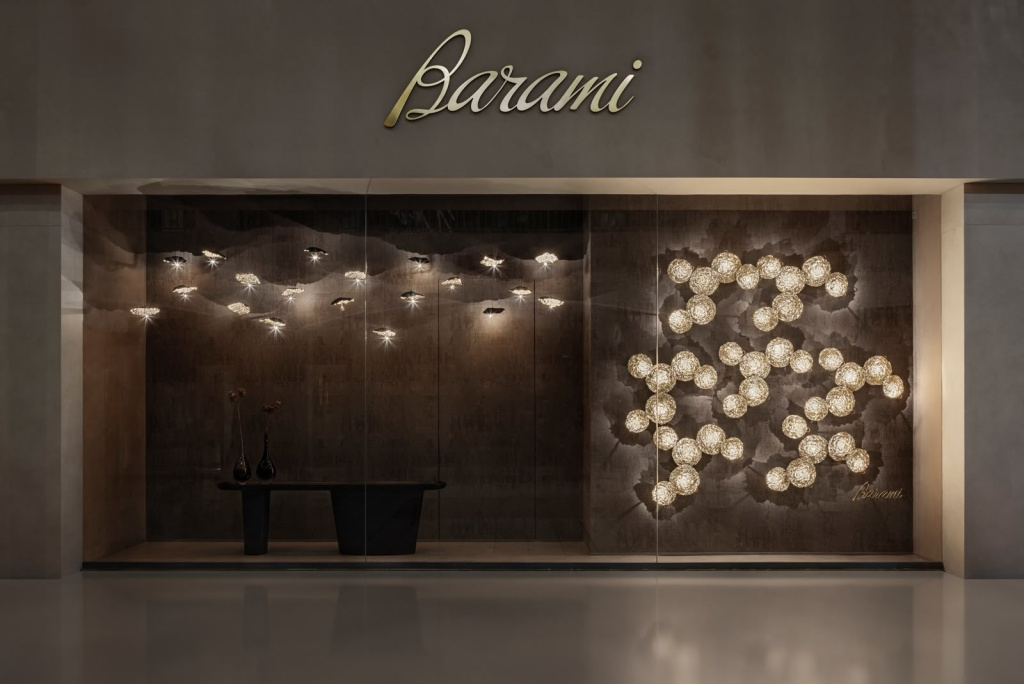
The site shows projects for shops and shopping centres, including NIKE Ramat Aviv branch, FOX Ramat Aviv, Foot Locker, SWAROVSKI, Hermitage, iDigital in Ramat Aviv Mall, iDigital at Azrieli Tel Aviv, Padani, Renbi and Mahsanei Hanamal. They show how tracks, adjustable spotlights and wall light work together in shops of different kinds.
To plan a commercial project you can contact Barami Lighting. See also the guide to planning and choosing project lighting.
Questions and answers
How much light does a store need?
The European standard for the lighting of workplaces, EN 12464-1, specifies about 300 lux for a normal sales area and 500 lux in large stores and at the checkout. On top of the general light, accent lighting is added on the merchandise, which is the main thing.
What is an accent ratio?
The ratio between the light on the highlighted product and the general light around it. A ratio of 3 to 1 is noticeable, 5 to 1 stands out, and 10 to 1 and above is dramatic. Luxury stores usually work with high ratios and relatively low general light.
Which colour temperature suits a clothing shop?
Usually 3000K to 3500K, with colour rendering of 90 and above and a good R9 value, so that fabrics and skin tones look right. Sports and young-fashion shops sometimes choose 4000K for a more energetic feel.
How to light a fitting room?
From the front and the sides, at face height, and not only from above. Light from above alone creates shadows on the face and the body. A warm-neutral colour temperature and high colour rendering help the customer see the garment as it really is.
Track or recessed spotlights in a shop?
Most shops use a track, usually three-phase, because the display changes and the spotlights have to move with it. Recessed spotlights suit general light, aisles and shops where the display is fixed.