















Magnetic Track or Standard Track: What’s the Difference, How Magnetic Lighting Works and What Suits You
The article
In short: a standard track works at mains voltage of 230V, and each spotlight comes with its own driver. A magnetic track, also called a magnetic rail, works at low voltage, usually 24V or 48V, from a central power supply, and the fixtures lock onto it magnetically and are moved by hand. A track is a strong, flexible choice for shops and high ceilings; a magnetic track gives a thin, clean line and a wide range of modules, and is especially suited to homes and plasterboard ceilings. With both, it is important to plan the position, the load and the dimming method in advance.
Lighting tracks solve a simple problem: how to get many aimed points of light that can be moved and changed, without cutting in a power point for each one. In shops this is the obvious solution. In homes, magnetic lighting, that is, a magnetic track in which the spotlights and modules lock by magnet, has in recent years become a common choice in kitchens, corridors and living rooms. The guide explains the difference between the two families and how to choose.
Track: the classic system
A track is an aluminium profile with copper conductors running along it. The spotlights connect to it with an adaptor and can be moved along its whole length. Each spotlight has its own driver, inside the fixture or in a box on the adaptor, so the track itself is simple: it carries mains voltage, just like a power line.
Single-circuit or three-phase
On a single-circuit track all the spotlights switch on together. On a three-phase track (three circuits) each spotlight is connected to one of three circuits, so three groups can be operated separately on the same track: for example general light, light on the shelves and light for the shop window. For example, the Flexalight 230VAC track is a three-phase track for surface or suspended installation, with accessories for connecting several tracks.
When a track is the right choice
- Stores, showrooms and galleries, where the merchandise moves and the lighting needs to move with it.
- High ceilings and concrete ceilings, where a track is easy to suspend or mount flush.
- When especially powerful spotlights are needed, each of them drawing tens of watts.
You can see tracks at work in Barami projects, for example in the NIKE store, in the FOX store in Ramat Aviv and in the Renbi store.
Magnetic track (magnetic rail): the slim generation
A magnetic track is a narrow profile that carries low voltage (DC), usually 24V or 48V, from one power supply or several supplies feeding the whole line. The fixtures, usually called “modules”, lock into it with a magnet and connect electrically through contacts. You take them out and move them by hand, without tools.
The main advantages:
- A narrow profile, which in the recessed version looks like a slot in the ceiling.
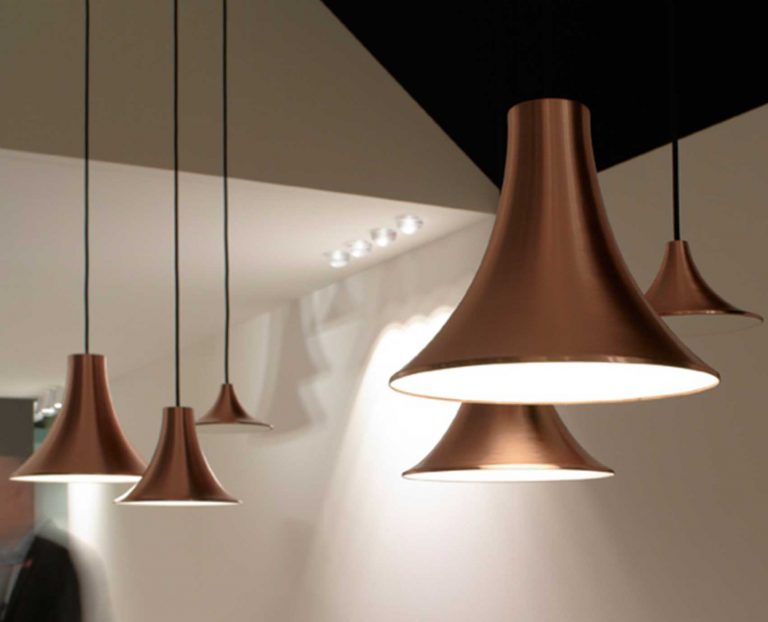
- A range of modules: spotlights, diffused light bars, linear modules with small spotlights, and even pendant fixtures that connect to the same track.
- Small fixtures, because the driver is not in each fixture.
Examples from the catalogue: the Maggy 36 and Maggy 72 system by Flexalight, linear tracks to which the lighting modules attach with magnets and slide along the slots; the 24VDC track for surface or suspended installation, and the 24VDC Trimless version for frameless recessed installation. The 24VDC track also has modules in a wall washer version, such as Lad T10 wall washer, which light a whole wall evenly (on wall washing and floodlighting). On the decorative side, Sistema U is a track onto which the fixtures attach and from which they are removed by magnet.
Quick comparison
| Track (230V) | Magnetic track (low voltage) | |
|---|---|---|
| Track voltage | Mains voltage | Usually 24V or 48V DC |
| Driver | In every spotlight | Central power supply for the line |
| Profile width | Wider | Narrow, especially in the recessed version |
| Types of fixtures | Mainly spotlights | Spotlights, linear, diffused and pendant |
| Compatibility between manufacturers | Available within standard families | Almost none |
| Power per fixture | Very powerful spotlights too | Usually smaller fixtures |
| Particularly suited to | Stores, high ceilings | Homes, offices, plasterboard ceilings |
Installation: surface-mounted, suspended or recessed
Surface mounting fixes the track to the ceiling. It suits concrete ceilings and renovations where no dropped ceiling is built. Suspended mounting lowers the track on cables, and suits high ceilings and double-height spaces, because it brings the light closer to the target. Recessed mounting sets the track into a plasterboard ceiling; in the Trimless version it is built in with a special profile before the skim coat, and the edge disappears into the ceiling. The decision on recessed mounting has to be made before the plasterer starts.
Power supply and load: the part that is easy to forget
With a magnetic track, the power supply is part of the design. Three things that must be checked:
- Total power: add up the power of all the modules, and leave a margin. A common rule is not to use more than about 80 per cent of the power supply’s capacity.
- Voltage drop: at low voltage, a long line with many fixtures may suffer a voltage drop at the far end. The maker specifies a maximum length and load, and sometimes the line needs to be fed from the middle or from two points.
- Position of the power supply: in a ventilated place accessible for maintenance, for example above a service hatch in the ceiling, not inside a closed wall.
On a 230V track the check is simpler: the track has a maximum current (for example 16 amps), and you count the spotlights on each circuit.
Dimming and control
On a track, the dimming is determined by the driver in each spotlight: spotlights that support phase dimming (TRIAC), spotlights that receive a DALI command through a track with data conductors, or wireless spotlights. On a magnetic track, dimming is usually done at the central power supply, for example by DALI, 0-10V or a wireless system such as Casambi, and some systems allow each module to be controlled separately. The full explanation is in the guide to LED dimming and drivers.
A few planning tips
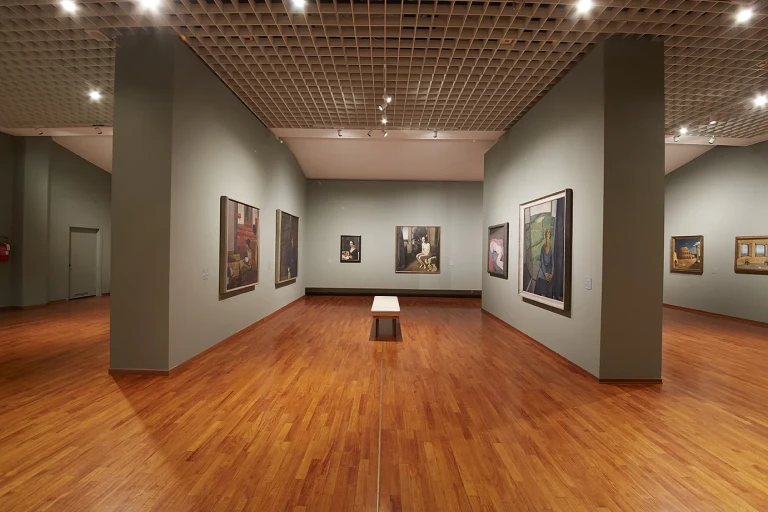
- The position of the line matters more than the number of fixtures. A track along a wall of pictures or shelves should be at a distance that lets you aim the light at an angle of about 30 degrees to the centre of the wall, not directly above it.
- In the kitchen, a track above the worktop is better than a track in the middle of the room, so that the light does not come from behind the person standing at the worktop.
- In a corridor, a magnetic track with a diffused light module along it and a few spotlights aimed at pictures gives general light and accent light on a single line.
- Beam angles and glare matter as much as with recessed spotlights. See the guide to choosing recessed spotlights.
- Consistency: the same colour temperature and the same colour rendering in all the modules. On a long track, any difference in colour temperature stands out immediately.
Common mistakes
- A track in the middle of the room. It looks natural on the plan, but lights the floor rather than what is on the walls. In most spaces the track should run parallel to the wall being lit, at a distance that allows an angle of about 30 degrees.
- A recessed track without a suitable profile. A late decision on recessed mounting sometimes ends with cutting into the finished plaster and uneven edges.
- A power supply chosen “on the edge”. After two more modules are added, the power supply runs at full load, heats up, and sometimes the light starts to flicker.
- Mixing modules from different systems. Even when something seems to “fit”, the contacts and the voltage do not necessarily match.
- Forgetting circuits. With a single-circuit track in a shop, all the spotlights switch on together, and you cannot leave only the shop window lit at night.
Questions to ask before ordering
- What is the system’s voltage, and what is the maximum power per line?
- Which modules does the series offer today: spotlights, linear, diffused, pendant?
- Is there a trimless recessed version, and what needs to be prepared in the plaster?
- Which dimming method is supported, and where does the power supply sit?
- Can modules from the same series be added in a few years’ time?
So what to choose?
In a shop, a gallery or a high space where the display changes every season, a three-phase track with powerful spotlights is still the flexible and economical solution. There is a separate guide on shops and showrooms. At home or in the office, in a plasterboard ceiling, when you want a clean line and a variety of types of light on one track, a magnetic track is more suitable. And in both cases, choose one system and stay with it, because changing maker later usually means replacing the whole track.
For all models: Spotlights and tracks. For overall planning of the home: How to plan lighting for a whole flat.
Questions and answers
What is the difference between a track and a magnetic track?
A standard track carries 230V mains voltage, and each spotlight connected to it has its own driver. A magnetic track carries low voltage from a central power supply, and the fixtures lock into it by magnet. The magnetic track is usually narrower and also offers linear and pendant modules, but it requires planning of the power supply and the load.
Can one maker’s spotlights be connected to another maker’s track?
For three-phase tracks there are several recognised standards, and adapters of the same standard family usually fit across makers too. With magnetic tracks there is almost never compatibility: the track, the modules and the power supply have to be from the same system.
What is a three-phase track?
A track with three separate circuits. Each spotlight is connected to one of them, so three groups of spotlights can be switched on and off separately on the same track. This is the common choice in shops, because it allows day, evening and shop-window lighting on the same track.
Is a magnetic track suitable for the home?
Yes, especially in the kitchen, the corridor and a living room with a picture wall, and when you want a clean line of light in a plaster ceiling. An accessible place for the power supply has to be planned in advance, and the recessed version decided on before the plaster work.
How many fixtures can go on one track?
It depends on the power supply and the permitted load of the track. An accepted rule is not to use more than about 80 percent of the power supply’s power. On long low-voltage tracks an additional feed is sometimes added to prevent voltage drop.